On this page
- Read this first
- The beginner's paradox: why "less" felt like "more"
- Why you understand Japanese but can't speak it
- The JLPT paradox: an N1 that can't order coffee
- Living in Japan doesn't fix it either
- The community debate, and where it lands
- The standard advice, honestly graded
- The real gap: feedback without judgment
- A 10-minute daily output routine (works with any tools)
- Where HayaiLearn fits
- The Bottom Line
Read this first
You can understand Japanese but can't speak it. You follow the anime without subtitles, you clear your flashcards, maybe you passed a JLPT level. Then someone asks you a simple question out loud and your mind goes blank.
Here's a sentence a learner posted on a Japanese-study forum that I think about constantly:
"The problem I'm having now is I absolutely cannot speak. I feel like I could speak more when I was an absolute beginner."
She'd studied on and off since she was fifteen. She worked at a Japanese restaurant for two years just to be near the language. Her partner is Japanese. She described trying to speak as her mind "going completely blank," her "skin crawling," feeling "nauseated and guilty" just writing about it.
If you felt a little jolt of oh, that's me, this post is for you. Because the most disorienting part isn't that you can't speak. It's that you're pretty sure you used to be better at it, back when you knew almost nothing.
That paradox is real, and there's a reason for it. You don't have a talent problem or a discipline problem. You have a skill problem, and skills are fixable.
The short version
- Input trains comprehension. Output trains production. They are two different skills, and doing one does not build the other.
- This is one of the most documented findings in language research, not a personal failing. Krashen was right that input builds understanding. Merrill Swain proved input alone leaves speaking behind.
- The missing ingredient in almost every fix ("just get a tutor," "use HelloTalk," "talk to yourself") is a feedback loop at low social stakes. Solo practice gives you no feedback. Human practice gives you feedback at maximum embarrassment.
- You can start closing the gap today, in ten minutes a day, with tools you already have.
One mantra for the whole piece: you get good at exactly what you practice. Say it a few times. It explains everything below.
The beginner's paradox: why "less" felt like "more"
When you were a beginner, you had nothing to protect. You said "sushi, oishii!" with your whole chest because there was no version of you that could be embarrassed. Your standards were on the floor. Every word out of your mouth was a bonus.
Then you got good at understanding. You watched hundreds of hours of video, cleared decks of flashcards, maybe passed a test or two. And somewhere in there you acquired the one thing that makes speaking harder: an ear good enough to hear your own mistakes.
Now you have an identity to protect ("I'm the person who's studied for three years"). You have a standard high enough to make everything you produce sound embarrassing to your own ears. You have enough knowledge to know exactly how wrong you are in real time. The beginner had none of that. So the beginner talked.
Another learner on the same forum described the loop perfectly: a stiff, failed conversation makes you "blame and berate ourselves for our failure to speak properly, which can then lead to increased anxiety in the following conversations, which can then lead to avoidance, and then we're stuck on a loop."
Your comprehension leveled up. Your courage leveled down. Your inner monologue has an N1. Your mouth is still on a trial version.
Why you understand Japanese but can't speak it
Here's the good news: you're not broken, and you're not lazy. You're living inside one of the best-documented findings in second-language research. Four names explain almost the whole thing.
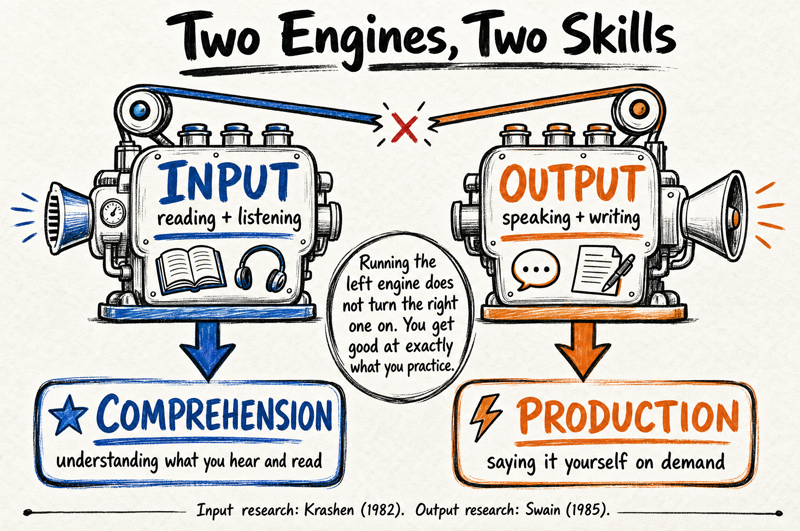
Stephen Krashen (1982): input is the engine. Krashen argued that we acquire language by understanding messages slightly above our current level, his famous "i+1."1 He was right about a lot. Immersion works. Comprehension is built by consuming tons of understandable input. That's why you can follow a slice-of-life show without subtitles. But he made a bigger claim too, that speaking would simply emerge from enough input. That last part is where a lot of immersion-first learners get stranded. Input is necessary. It is not sufficient.
Merrill Swain (1985): output is a separate engine. This is the backbone of the whole piece, and the story is almost too on-the-nose. Canada ran French immersion programs where English-speaking kids studied every subject in French for years. They got thousands of hours of rich, understandable input. The result? Their comprehension reached near-native levels. Their production did not. After years of immersion they still made basic grammar errors and still couldn't produce French like natives.2
Read that again and swap the nouns. "Thousands of hours of input, near-native comprehension, production lagged behind" is the same sentence as "I've watched 500 hours of anime and I still can't order ramen." Swain proved your exact problem in a Canadian classroom forty years ago. She found three jobs only output can do: noticing (you open your mouth and discover you can't say something), hypothesis testing (you try a sentence and see if it works), and forcing grammar (producing makes you build the sentence instead of gisting past it).
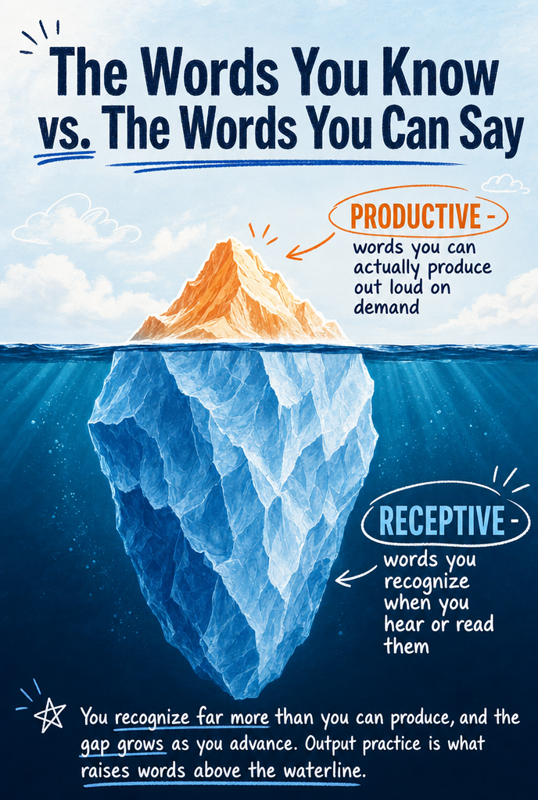
Nation and Laufer: you know more words than you can use. Researchers split word knowledge into receptive (you recognize it when you see or hear it) and productive (you can summon it yourself, correctly, on demand). Producing a word takes deeper knowledge than recognizing one, and the productive set is a fraction of the receptive one. Worse, the gap widens as you advance. Laufer found the ratio of active to passive vocabulary actually fell as learners got more advanced, not better.3 So "I know this word, why won't it come out" is not a glitch. Recognizing a word and deploying it are two different skills, and you only trained one.
Robert DeKeyser: you get good at exactly what you practice. Skill research says knowledge moves from "I know the rule" to "I can just say it" only through practicing that specific skill, and skills don't transfer as much as you'd hope. In one study, learners trained on hearing Mandarin tones, or on producing them, were then tested on both. Performance was far worse on the skill they hadn't practiced.4 Translation: a thousand hours of listening builds a world-class listener. It does not build a speaker. You maxed your Listening stat and left Speaking at level 3.
Elaine Horwitz (1986): the anxiety is its own beast. Foreign-language anxiety is a distinct thing, built from communication apprehension, test anxiety, and fear of being judged, and it has its own validated scale.5 It is not the same as being generally shy. And it feeds the avoidance loop: you're anxious, so you don't speak; you don't speak, so you don't improve; you don't improve, so speaking stays scary. Krashen had a name for this wall: the "affective filter." Stress physically blocks the language you already have.
Put it together and the picture is almost reassuring. Comprehension and production are different skills (Swain), built on different depths of knowledge (Nation and Laufer), made automatic only through skill-specific practice (DeKeyser), and gated by a specific anxiety (Horwitz). You didn't fail. You trained one skill and expected the other one for free.
The JLPT paradox: an N1 that can't order coffee
Nothing exposes the gap like the JLPT. Here's what many learners realize too late: the JLPT has no speaking section, and no writing-production section at all. It tests vocabulary, grammar, reading, and listening. Recognition and comprehension, top to bottom. You can earn a certificate that says "advanced" without ever producing one spoken sentence under evaluation.
So you get stories like this, from a learner on a study forum:
"I have friends who can't understand a normal everyday Japanese conversation who have passed N2. I even have an acquaintance who works as a JP-to-English translator, has passed N1, but claims to be unable to speak or understand any spoken Japanese."
An N1 is a real achievement. But treating it as a fluency certificate is like getting a black belt for watching every UFC event. The test measures what you know about Japanese, not what you can do with it in real time. Same skill split, different outfit.
Living in Japan doesn't fix it either
You'd think moving to Japan would auto-solve this. Surrounded by the language, forced to use it. For a lot of people, that's not how it goes.
There's the foreigner bubble: the English-teaching job where you speak English all day, the friend group of other foreigners, the partner happy to translate. You can build a life in a Japanese city that needs almost no Japanese output. One learner in a big Japanese city described exactly this, always leaning on a partner "who speaks the same level of Japanese as I do, just without the fear of speaking, so it's easy to fall back on him."
There's the switch to English. You work up the nerve, you produce your carefully assembled sentence, and the other person answers in English to be kind. Every hesitation reads as "this'll be faster in English," and the door to practice quietly closes.
And there's the final boss: the konbini gauntlet. With more than 56,000 convenience stores across Japan, this is the most common speaking test you'll ever take, and nobody scheduled it.6 You put your bento on the counter and the clerk fires off a rapid sequence at native speed:
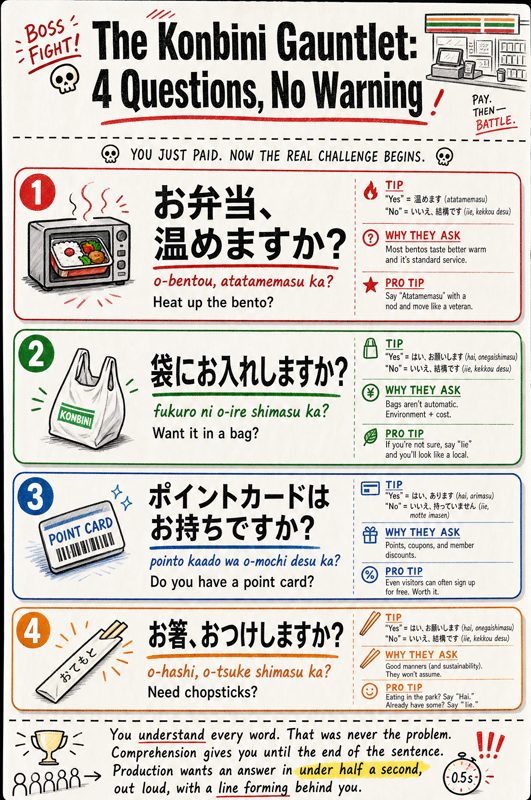
You understand every word. That's not the problem. Comprehension gives you until the end of the sentence to catch the gist. Production demands an answer in the next fraction of a second, out loud, with a line forming behind you. And real Japanese moves. In our library of unscripted Japanese video, the words fly by at roughly eight characters a second, a new one about every 120 milliseconds.7 Even the slowest tenth of speech still clips along at about four a second.
Here's a mundane line from a real travel vlog in the corpus, someone tasting a snack:
That's 「ちょっと甘みある気がする」, "it feels a little sweet." Thirteen characters in a little over one second. You understood it easily. Now picture having to reply that fast. Comprehension never trained that. So you default to はい to everything and walk out with heated ice cream and chopsticks you didn't want.
The community debate, and where it lands
Go looking for advice and you'll walk into a decade-old holy war. On one side, the input purists in the Krashen tradition, popular on YouTube, who argue that if you consume enough understandable input, speaking emerges almost on its own. Some advanced learners really do describe it that way, years of immersion and then the words "activate" once they join a friend group.
But even those stories quietly make the output case. The speaking didn't happen until they started speaking with actual people. And plenty of very advanced immersion learners admit that each time they open their mouths, they still have to double-check the sentence in their head first. That's the gap talking. Comprehension can be effortless while production is still manual labor.
The honest synthesis is boring but true. Input is necessary and builds the foundation fast. Output is a separate skill you eventually have to train on purpose. The purists are right that you shouldn't force painful output on day one with nothing in the tank. The output side is right that "it'll emerge on its own" strands most people exactly where our forum poster is. Comprehension sky-high, mouth frozen.
The standard advice, honestly graded
The internet's advice for this is not wrong. It's just incomplete, and it rarely admits its own failure modes. Let's grade it.
| Method | What it's good for | Where it fails |
|---|---|---|
| Get a tutor (italki, Preply) | Real output practice with feedback, the gold standard | Costs money per hour, must be scheduled, and a live human watching you fail is the exact trigger anxious learners avoid |
| Language exchange (HelloTalk, Tandem) | Real conversation when it works | Partner often wants free English; peers can't tell you why a sentence was wrong; timezones and awkwardness |
| Shadowing | Excellent for pronunciation, rhythm, mouth training | It's repeating someone else's words, not generating your own under pressure |
| Talk to yourself | Free, zero anxiety, builds the sentence-making habit | No feedback loop at all, so you just get fluent at your own mistakes |
See the pattern? Every solo method has no feedback. Every human method delivers feedback at maximum social cost. That's the actual hole in the map.
None of these are bad. Do them. A tutor plus shadowing plus daily self-narration will genuinely move you. I'm not here to sell you out of the free options. I'm here to point at the missing piece they all dance around.
The real gap: feedback without judgment
So here's the question almost nobody asks: what would output practice look like if it had a feedback loop but no social stakes, and used the exact words you're currently learning?
It would let you fail in private, the way the beginner failed in public: cheaply, endlessly, with no audience. It would correct you, so you're not just drilling mistakes like the talk-to-yourself crowd. It would build scenarios around the vocabulary you're actually studying, so you're producing words already halfway to your tongue. And it would separate your skills so you can see the imbalance instead of vaguely feeling it.
That's also the environment the motivation research points to. Self-determination theory says motivation runs on three needs: competence (a sense you're improving), autonomy (you're in control), and relatedness (a safe connection).8 A patient, always-available practice partner that lets you retry without shame hits all three, and drops the affective filter that's been blocking the Japanese you already have.
Before the fix, get honest about your own split. Most people who read this far are a lopsided build: maxed Listening, level-three Speaking. Seeing it on paper is oddly motivating.
A 10-minute daily output routine (works with any tools)
You do not need a flight or a tutor to start today. You need ten minutes and the willingness to be bad in private. This routine hits all three of output's jobs: noticing, hypothesis-testing, and making it automatic.
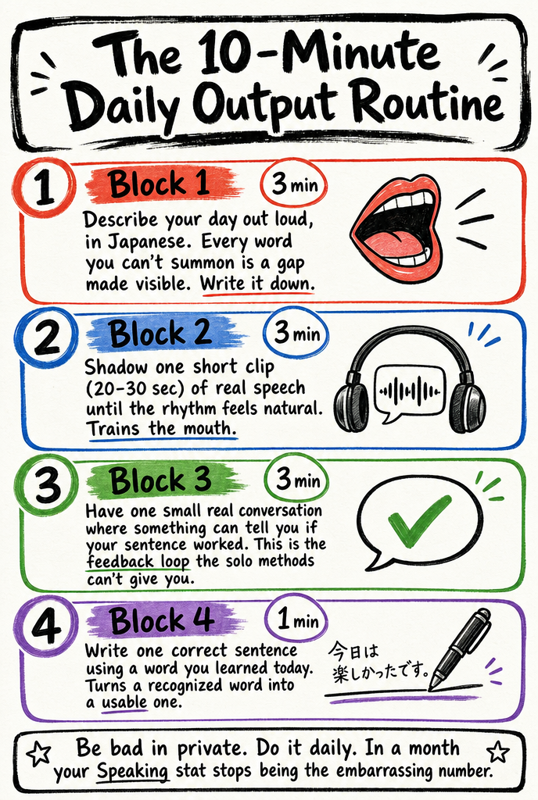
- Describe your day out loud (3 min). Narrate what you did, in Japanese, out loud. Every time you hit a wall, a word you can't summon, that's Swain's "noticing" firing. Write the missing word down. That's your gap, made visible.
- Shadow one short clip (3 min). Pick 20 to 30 seconds of real speech and mimic it until the rhythm feels natural. This trains your mouth so it isn't the bottleneck when your brain finally sends the sentence.
- Have one small real conversation (3 min). The non-negotiable one. Produce novel sentences and get told whether they worked. A roleplay, ordering at a shop, answering the konbini questions, where something or someone can tell you if your sentence landed. This is the feedback loop the solo methods can't give you.
- Write one sentence with today's words (1 min). Take a word you met today and produce one correct sentence with it. That's how a recognized word becomes a usable one, one word at a time.
Here's the encouraging part, and it's backed by the data. Real spoken Japanese is short. In HayaiLearn's unscripted-video corpus, the median spoken line is only about seven words long. Half of all lines are seven words or fewer, and three-quarters are under ten.7 You are not being asked to build paragraphs. You're being asked to build one short, true sentence, then another. And a tiny set of words does most of the talking: the 50 most common everyday words cover more than a quarter of everything people say, and the top seven are just する (do), 言う (say), 思う (think), ある (there is), なる (become), ちょっと (a little), and なんか (like, somehow).7 The words you need to say are words you already recognize.
Do this daily and in a month your Speaking stat stops being the embarrassing number on your sheet. Not because you got braver. Because you finally trained the skill you'd been expecting for free.
Where HayaiLearn fits
Everything above is true whether or not you ever touch our product. If the free routine is all you do, you'll still get there. But if you've read this far, you can probably see the shape of what we built, because we built it around this exact problem.
HayaiLearn starts with immersion. You learn by watching real YouTube and Netflix content, with AI-parsed subtitles, a popup dictionary that shows the meaning for this sentence, and one-tap sentence mining. That's the Krashen half done well: understandable input from stuff you actually enjoy. But we refuse to pretend that's the whole job. So the Dojo is where output lives:
- Roleplay builds short conversation scenarios, the shop clerk, the customer, the konbini counter, around the exact words and grammar you're currently learning. The AI voices the other character out loud. You answer by typing or speaking. It tells you, in plain language, whether your sentence got the meaning across and held together. That's the feedback loop at zero social cost, the thing talking to yourself can't do and a stranger chasing free English lessons won't.
- Shadowing with pronunciation grading trains the mouth.
- The XP system tracks every word across four skills, Reading, Listening, Writing, and Speaking, grouped into Input and Output. When your Output lags, your level shows a gate telling you exactly how much you owe. It's your skill gap turned into a progress bar you can actually close.
Typing earns Writing XP. Speaking earns Speaking XP. The beginner who "could speak more" comes back, this time with a good ear and a trained mouth.
The Bottom Line
You didn't fail at Japanese. You succeeded at half of it. You built the comprehension, which is the slow, unglamorous half most people never finish. That's worth being proud of.
The other half has a different engine, and you turn it on the same way you turned on the first: reps, at your level, with feedback, every day. Remember the mantra. You get good at exactly what you practice. So practice the thing you actually want, which is talking.
Be bad in private. Ten minutes a day. Then go say it out loud somewhere it's safe to get it wrong. You've done the hard part already.
References
-
Stephen Krashen, Principles and Practice in Second Language Acquisition (1982), which lays out the Input Hypothesis, "i+1," and the affective filter. ↩
-
Merrill Swain, "Communicative Competence: Some Roles of Comprehensible Input and Comprehensible Output in Its Development" (1985), based on Canada's French immersion programs, where learners reached high comprehension but lagging production. This is the origin of the Output Hypothesis. ↩
-
Batia Laufer, "The Development of Passive and Active Vocabulary in a Second Language: Same or Different?" Applied Linguistics 19(2), 1998, which found the active-to-passive vocabulary ratio did not grow, and could shrink, as proficiency rose. ↩
-
Shaofeng Li and Robert DeKeyser, on perception versus production practice in learning Mandarin tones (Studies in Second Language Acquisition, 2017): learners performed far worse when tested on the skill they had not practiced. ↩
-
Elaine Horwitz, Michael Horwitz, and Joann Cope, "Foreign Language Classroom Anxiety," The Modern Language Journal 70(2), 1986, which defined the construct and introduced the 33-item Foreign Language Classroom Anxiety Scale. ↩
-
Convenience-store totals from the Japan Franchise Association's national statistics, reported via The Japan Times (2026). Independent tallies put the figure between roughly 56,000 and 58,000 stores. ↩
-
Original analysis of HayaiLearn's caption corpus (about 9.6 million Japanese subtitle lines). We drew random samples of 250,000 to 350,000 lines, then kept only unscripted YouTube content (vlogs, interviews, gaming, podcasts, cooking and travel, teachers speaking naturally) and excluded anime, films, dramas, music, and Netflix, since those are scripted or sung. Speed is measured per on-screen character from the corpus's word-timing data; line length is counted in analyzed words. Figures describe that unscripted sample, not every Japanese speaker. ↩ ↩2 ↩3
-
Richard Ryan and Edward Deci, "Self-Determination Theory and the Facilitation of Intrinsic Motivation, Social Development, and Well-Being," American Psychologist 55(1), 2000. ↩