On this page
- Intro
- The "hardest language" reputation is based on the wrong goal
- What you can actually skip (and why that's not cheating)
- So how hard is casual spoken Japanese, really?
- Casual Japanese is a finite set (we have the data)
- What actually makes spoken Japanese tricky
- Your actionable guide to better listening
- Your actionable guide to better speaking
- Why immersion works (when done right)
- The science that makes all of this work
- The bottom line
Intro
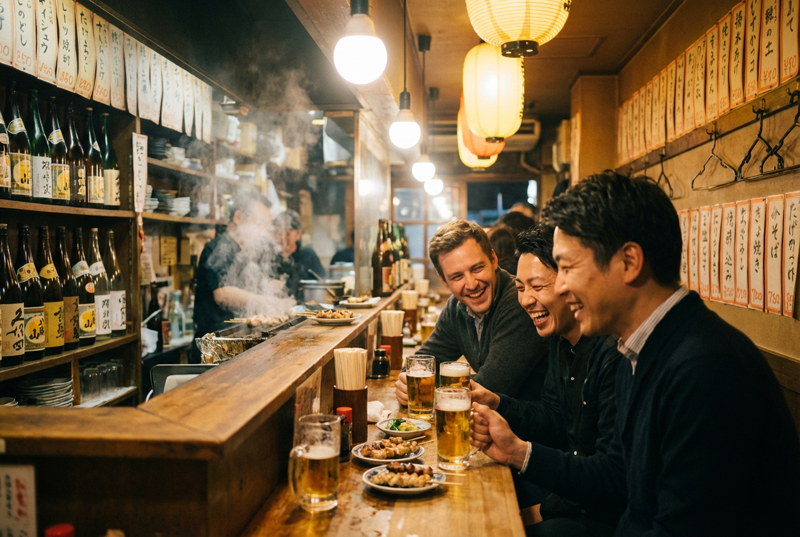
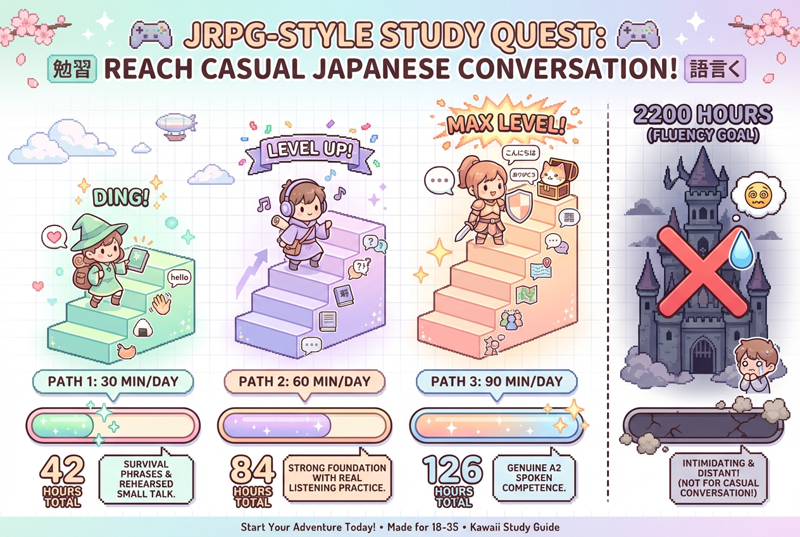
Everyone quotes the same scary number. 2,200 hours. That's how long the U.S. Foreign Service Institute says it takes to learn Japanese.1
But here's what nobody tells you: that number is for diplomats. People who need to read government documents, write formal reports, and navigate complex political conversations in honorific Japanese. Full literacy. Full formality. The whole thing.
You just want to chat with people at a bar in Tokyo.
Those are not the same goal. And they don't require the same effort. Not even close.
The "hardest language" reputation is based on the wrong goal
When people ask "is Japanese hard to learn," they're usually picturing the full package. Reading thousands of kanji. Writing three different scripts. Mastering the formal politeness system that even native speakers mess up sometimes.
And yeah, all of that together? That's hard. That's years.
But casual spoken Japanese is a completely different animal. If you strip away reading, writing, and formal keigo (the complex honorific system), you're left with something way more manageable.
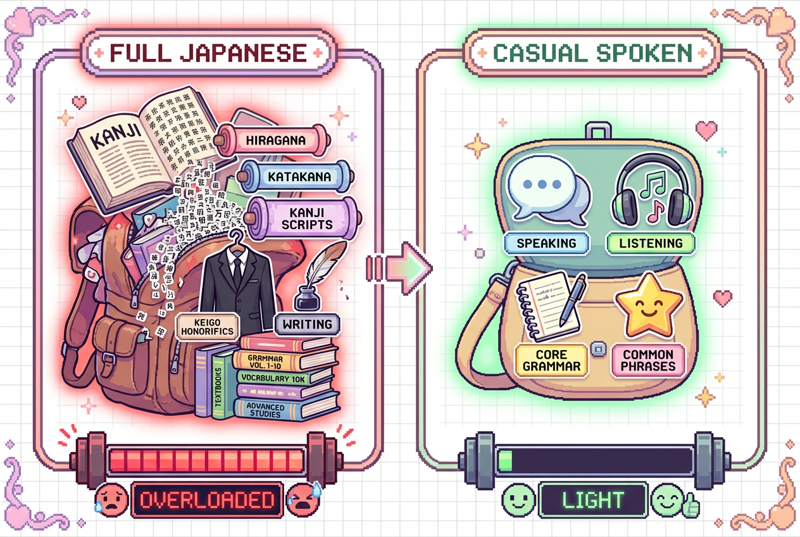
Think about it this way. The problem shifts from "learn an entire language plus three writing systems" to "build listening and speaking habits with a core set of grammar and high-frequency phrases."
Reddit learners put it bluntly: you can cut at least 20-30% of study time by focusing only on listening and speaking.2 And honestly? For casual conversation goals, the reduction is probably even bigger than that.
What you can actually skip (and why that's not cheating)
Here's something that might surprise you. Skipping reading and writing isn't lazy. It's strategic.
Cognitive neuroscience shows that reading and writing recruit and reorganize pre-existing brain systems.3 They're learned skills that humans invented, not something our brains evolved to do naturally. Speaking and listening? Those come way more naturally. Your brain is literally wired for them.
When you say "I just want to speak casual Japanese," you're removing the single biggest time sink in the entire learning process.
Japanese has three writing systems: hiragana, katakana, and kanji. Japanese students learn 2,136 standard kanji through school. That's over a decade of daily practice for native speakers. You don't need any of it to order ramen, make a friend at a hostel, or have a conversation about your favorite anime.
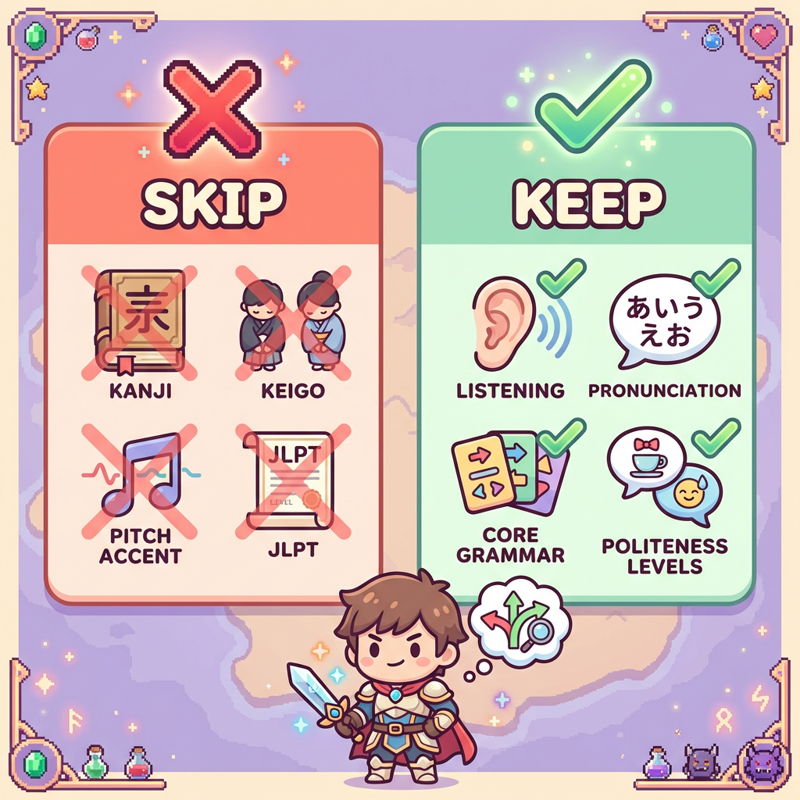
What you can skip:
- Learning to read and write kanji (the biggest time sink by far)
- Formal keigo (honorific/humble language for business settings)
- Perfect pitch accent (nice to have, not a dealbreaker for being understood)
- JLPT test prep (unless you actually need the certificate)
What you still need:
- Listening comprehension (understanding what people say to you)
- Basic pronunciation habits (clean vowels, vowel length, consonant length)
- Core grammar patterns (maybe 100-150 that cover most casual conversation)
- Two politeness levels: polite (です/ます) for strangers and casual for friends
That second list is very doable.
So how hard is casual spoken Japanese, really?
Let's talk real numbers instead of vibes.
There's no official "hours to casual Japanese conversation" chart. But we can work backwards from established benchmarks. Cambridge English estimates roughly 200 guided learning hours per CEFR level step. The British Council puts A2 (basic conversational ability) at around 180-200 hours.4
For Japanese specifically, you need to adjust upward for the grammar differences from English, but adjust downward because you're skipping the entire literacy workload.
Here's what that looks like:
A2 spoken ability (travel conversations, simple friend-making, ordering food, basic small talk): ~120-250 hours
Early B1 spoken ability (sustain longer small talk, explain simple opinions, handle unexpected situations): ~250-450 hours
To make that concrete:
- 30 min/day for 12 weeks = ~42 hours. Enough for survival phrases and rehearsed small talk. You can introduce yourself, order food, and handle basic travel situations.
- 60 min/day for 12 weeks = ~84 hours. A strong foundation if you pair it with real listening practice and weekly conversation.
- 90 min/day for 12 weeks = ~126 hours. Now you're in range for genuine A2 spoken competence, if your practice is mostly listening and speaking drills (not just tapping through an app).
Compare that to 2,200 hours and it's a completely different picture.
Casual Japanese is a finite set (we have the data)
Here's where it gets really interesting.
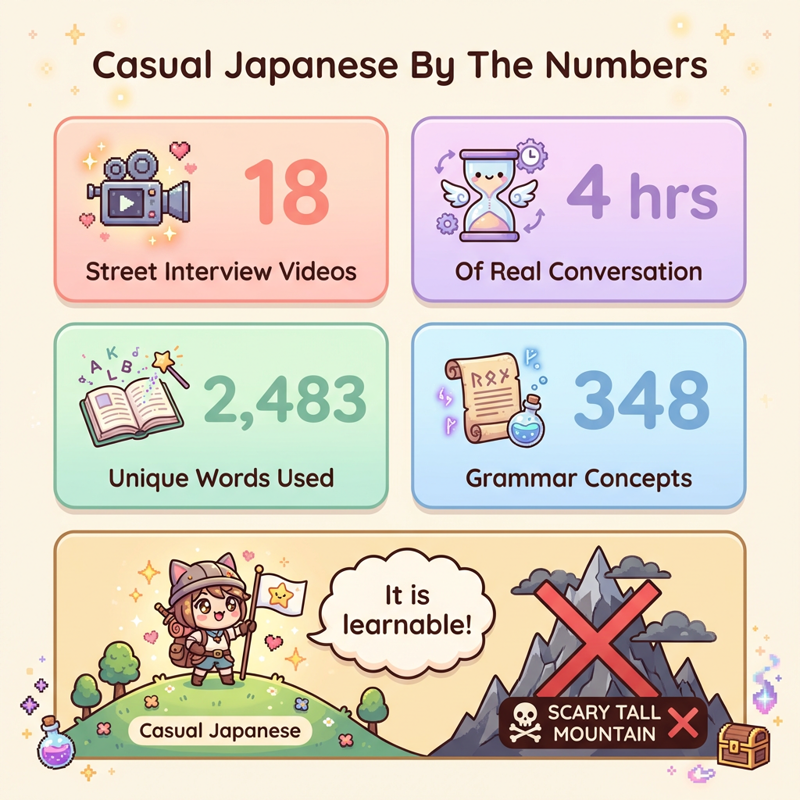
At HayaiLearn, we analyzed an album of 18 Japanese street interview videos, roughly 4 hours of real Japanese people having casual conversations on camera. Here's what we found:
- Vocabulary used: 2,483 unique words
- Grammar concepts used: 348
That might sound like a lot at first glance. But think about what this means.
Four hours of real, natural, casual Japanese conversation used fewer than 2,500 words. And a huge chunk of those words repeat constantly. The same greetings, the same question patterns, the same filler words, the same sentence endings.
The vocabulary and grammar in those street interviews IS the casual Japanese you need to learn. It's not an infinite mountain. It's a finite, learnable set. And the most common words and patterns do the heavy lifting in almost every conversation.
What actually makes spoken Japanese tricky

Let's be honest about the parts that ARE hard, even without reading and writing.
Particles will mess with your head. Japanese uses little words like は, が, を, and に to mark the role of each word in a sentence. They don't map cleanly to anything in English. Even advanced learners sometimes fumble these in real-time conversation. Research shows that particle selection places heavy demands on working memory, even for highly proficient speakers.5
The verb comes last. Japanese is an SOV (subject-object-verb) language. So you have to hold the whole sentence in your head until the very end, when the verb finally tells you what's actually happening. This takes getting used to.
Polite vs. casual switching. You need to control two layers. Polite (です/ます style) for strangers, shop clerks, and travel situations. Casual/plain forms for friends. Mixing them up isn't the end of the world, but learning to switch is a real skill.
Natural pacing. Japanese speakers don't pause where English speakers would. Your brain needs time to adjust to the rhythm.
But here's the good news: you can postpone formal keigo entirely. The honorific/humble system that even Japanese learners describe as "advanced difficulty" is not something you need for chatting with friends or traveling. Polite basics are enough to be socially appropriate, and casual forms are what you'll use most.
Your actionable guide to better listening
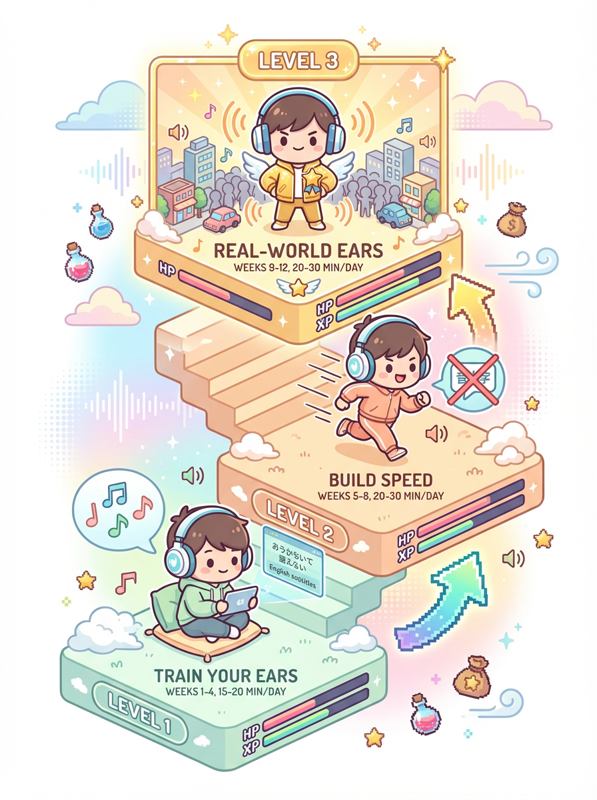
This is the section to bookmark. Listening is the foundation of spoken Japanese. If you can't hear it, you can't say it.
Level 1: Train your ears (Weeks 1-4)
Start with slow, clear speakers. Look for language-learning YouTube channels or interview-style content where people speak deliberately. Street interviews where the interviewer speaks slowly are gold.
Use short clips on repeat. Pick a 30-90 second clip. Listen once for the general meaning. Then loop it 3-5 times, each time trying to catch more.
Use subtitles as training wheels. Turn on Japanese subtitles (not English) while listening. This isn't cheating. It's scaffolding. The goal is to connect sounds to meaning.
Estimated Time: 15-20 minutes per day
Level 2: Build speed (Weeks 5-8)
Graduate to natural-speed content. Move to vlogs, casual YouTube, and street interviews where people talk normally.
Practice narrow listening. Pick one speaker or one topic and listen to multiple clips of the same person. Your brain calibrates to their voice, which makes it easier to parse the language itself.
Start tracking "no-subtitle minutes." How long can you follow the gist of a conversation without reading anything? This number is your real progress metric.
Estimated Time: 20-30 minutes per day
Level 3: Real-world ears (Weeks 9-12)
Listen in messy conditions. Background noise, overlapping speakers, fast-talking friends. Real life isn't a clean audio recording.
Extensive listening for meaning. Stop analyzing every word. Just listen and try to follow the story. If you get 60-70% of the meaning, that's great. Your brain fills in the rest over time.
Estimated Time: 20-30 minutes per day
Pro tip: The biggest friction with YouTube immersion is that you keep pausing to decode every word. Tools like HayaiLearn reduce that friction by giving you AI-powered subtitles with instant word meanings and grammar breakdowns, so you can stay in the flow instead of stopping every 5 seconds.
Your actionable guide to better speaking
Listening is half the battle. The other half is opening your mouth.
The shadowing loop (do this daily)
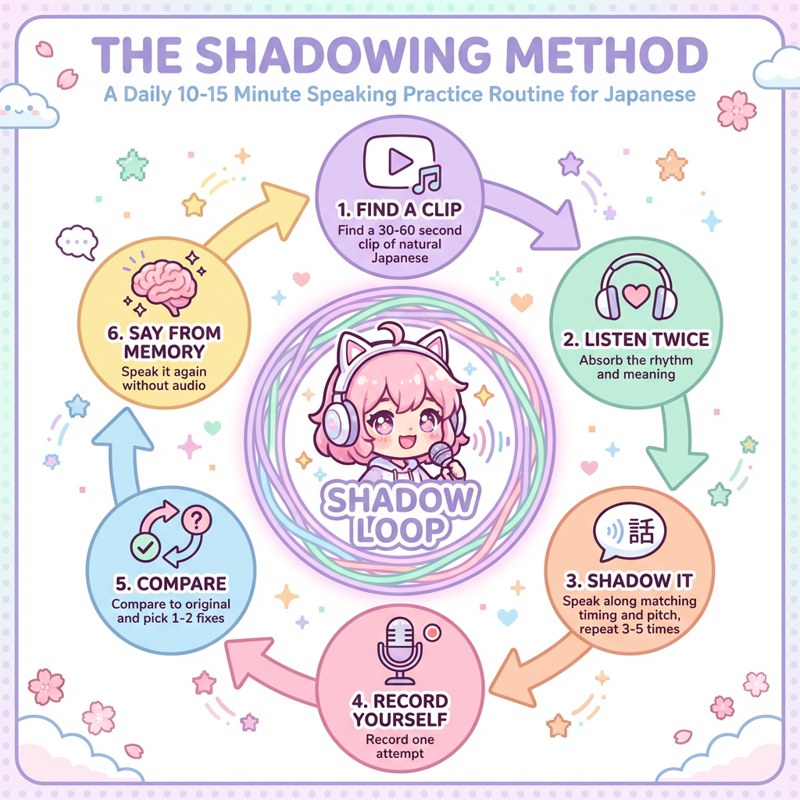
Shadowing is the single most recommended technique across hundreds of Reddit threads about learning to speak Japanese. Here's the method:
- Find a short clip (30-60 seconds) of natural spoken Japanese
- Listen twice to get the rhythm and meaning
- Shadow it 3-5 times (speak along with the audio, matching their timing and pitch)
- Record yourself once
- Compare to the original and pick 1-2 things to fix
- Say it again from memory
That's it. 10-15 minutes. Do it every day and your pronunciation, rhythm, and confidence will improve faster than any textbook could deliver.
Estimated Time: 10-15 minutes per day
Self-talk (surprisingly effective)
Narrate your day in Japanese. Making coffee? Say what you're doing. Walking to the train? Describe what you see. It sounds weird. It works.
This builds the habit of producing Japanese without the pressure of another person waiting for you to finish your sentence.
Learn "repair phrases" immediately
These four phrases are disproportionately powerful because they turn every failed conversation into more practice:
- もう一回お願いします (Could you say that again?)
- もうちょっとゆっくりお願いします (A little slower, please)
- ____は何ですか?(What does ____ mean?)
- つまり____ということですか?(So you mean ____, right?)
Learn these in week one. They turn mistakes into learning moments.
Don't wait until you're "ready"
This is the most important speaking advice in this entire post.
Across every Reddit thread about speaking practice, the same message appears: speaking skill tracks speaking minutes. Not studying minutes. Not "I'll start speaking when I know enough." Speaking minutes.
Output anxiety is completely normal. Almost every learner describes the same feeling: "I can understand some Japanese, but when I try to speak, my brain empties." That's not a sign you're bad at Japanese. It's a sign you need more speaking reps.
Talk to real people as soon as you can. Use language exchange apps. Use AI conversation tools for low-stakes practice. But get words coming out of your mouth early and often.
Why immersion works (when done right)
You've probably heard that immersion is the best way to learn a language. That's true, but with a big asterisk.
Raw immersion without support is like being thrown into the ocean before you can swim. Immersion works when it's comprehensible enough to keep you engaged AND paired with just enough structure to prevent you from zoning out.
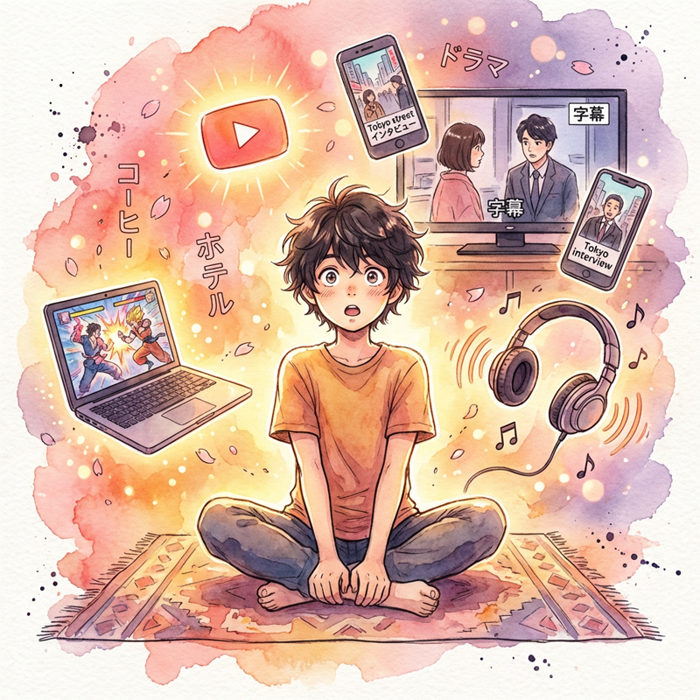
The good news: Japanese has one of the best immersion ecosystems in the world. Anime, YouTube, dramas, podcasts, street interview channels. There's an insane amount of enjoyable content.
And here's a bonus most people don't know: about 80% of loanwords in Japanese come from English.6 Words like コーヒー (coffee), レストラン (restaurant), and ホテル (hotel) are everywhere. Once you can hear katakana words, you get surprising "free vocabulary" moments constantly.
The smart immersion workflow
- Pick a short clip (30-90 seconds) with clear speech
- Listen once for the gist
- Turn on Japanese subtitles or a transcript
- Loop 3-5 times, noticing chunks and patterns
- Look up only 2-3 high-value words (not every unknown word)
- Shadow it
- Move on
This aligns with comprehensible input research and spaced repetition principles. You're not passively watching. You're actively building your ability to process spoken Japanese.
The science that makes all of this work
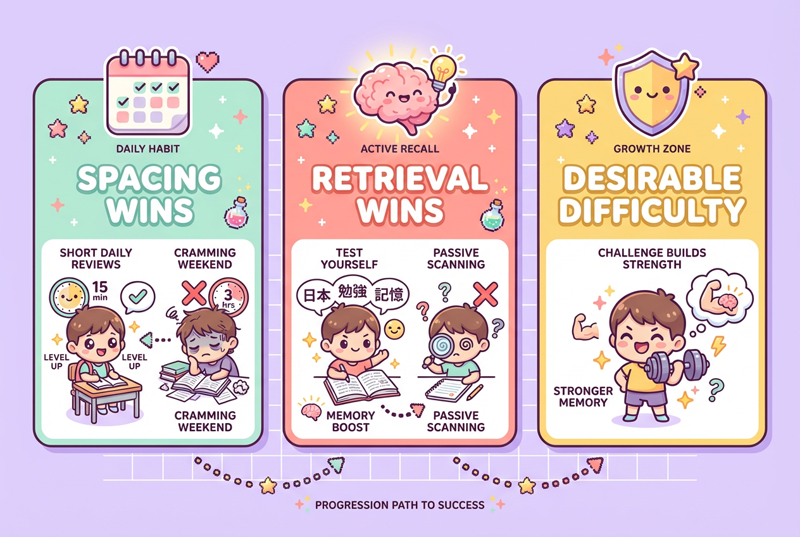
You don't need to be a learning science nerd to benefit from this. But knowing three principles will save you hundreds of wasted hours.
Spacing beats cramming. A major meta-analysis of distributed practice found strong evidence that spaced review crushes massed practice.7 For Japanese, this means 15 minutes every single day beats a 3-hour weekend cram session. Every time.
Retrieval beats re-reading. Research on the "testing effect" shows that pulling information from memory (flashcards, quizzes, "say it without looking") improves retention more than re-reading notes. Cover the English and produce the Japanese. That's your drill.
Make it a little bit hard on purpose. The Bjorks' research on "desirable difficulties" shows that practice conditions that feel slightly harder in the moment produce better long-term retention. For Japanese, this means: use shorter clips without subtitles instead of long videos you understand 10% of. Challenge yourself just enough to stay engaged.
Here's the single best reframe I found across all the research: Japanese feels hard when your input level (what you can actually understand) is way below your taste level (what you want to consume). Your job is to narrow that gap steadily, not close it in one leap.
The bottom line
Is Japanese hard to learn? If you're trying to read novels, write business emails, and navigate formal keigo, yes. It's a long road.
But if you just want to chat with people? Order food without pointing at pictures? Make friends at a bar in Osaka? Tell someone about your weekend in simple sentences?
That version of Japanese is not 2,200 hours. It's more like 120-250 hours of focused listening and speaking practice. That's 30 minutes a day for about 8-12 months, or 90 minutes a day for about 3-4 months.
Casual Japanese is a finite, learnable skill. Real street conversations use fewer than 2,500 unique words and around 350 grammar concepts. The same patterns repeat over and over. Your brain will pick them up if you give it consistent, focused input.
Stop comparing yourself to the diplomat timeline. Define your own goal. Start with slow speakers and short clips. Shadow every day. Talk to people before you feel ready.
The scary number was never your number.
References
-
U.S. Foreign Service Institute language training categories place Japanese in Category IV (88 weeks / ~2,200 classroom hours for "professional working proficiency"). ↩
-
Recurring theme across multiple r/LearnJapanese threads, including this discussion on spoken-only learning paths. ↩
-
Dehaene, S. (2014). Reading in the Brain Revised and Extended. Reading acquisition recruits and reorganizes pre-existing brain systems rather than being an evolved, innate module. ↩
-
British Council CEFR level guidance and Cambridge English guided learning hours. ↩
-
Morishita, M. et al. (2022). Neural underpinning of Japanese particle processing in non-native speakers. Scientific Reports. ↩
-
Association for Asian Studies teaching resource: Borrowing Words: Using Loanwords to Teach About Japan. ↩
-
Cepeda, N.J. et al. (2006). Distributed practice in verbal recall tasks: A review and quantitative synthesis. Psychological Bulletin. ↩